Search is no longer limited to a list of blue links. People now search through Google, AI Overviews, Google AI Mode, ChatGPT, Gemini, Perplexity, and other conversational experiences that can summarize information, compare businesses, and answer questions directly.
That creates a new challenge for businesses: how do you make sure your website and brand are visible wherever customers search? This is where three terms increasingly appear: SEO, AEO, and GEO.
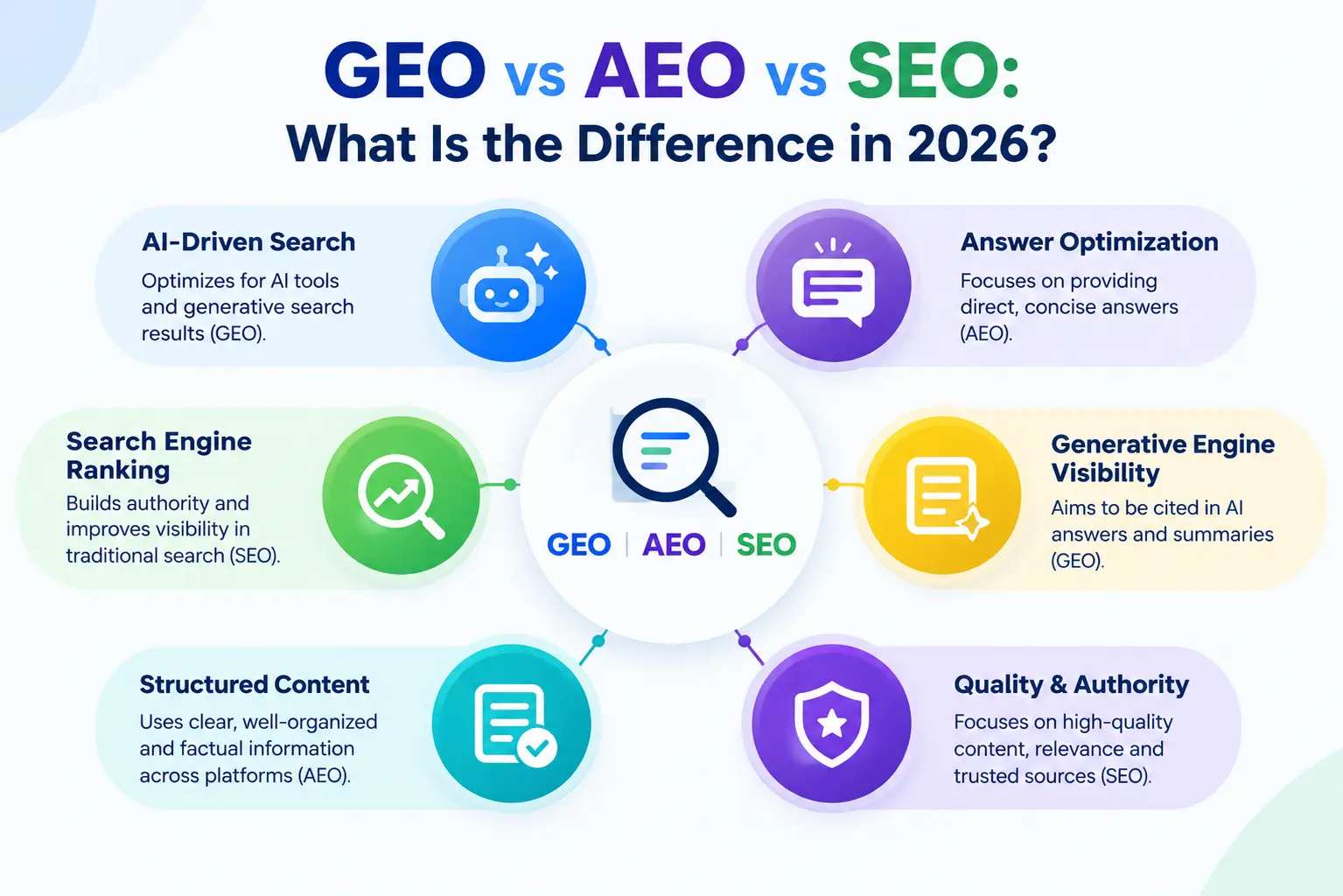
Although they are closely connected, they have different purposes. SEO focuses on improving visibility in search engines, AEO focuses on providing content that can become a direct answer, and GEO focuses on increasing the likelihood that a brand or its information is represented, mentioned, or cited in generative AI experiences. The important point is that businesses do not necessarily need three completely separate strategies — a strong technical and content foundation can support all three.
This guide explains GEO vs AEO vs SEO in 2026, how they differ, where they overlap, and how businesses can build one search strategy that supports traditional search and AI-powered discovery.
What Is SEO in 2026?
Search Engine Optimization (SEO) is the process of improving a website so search engines can discover, understand, evaluate, and rank its pages for relevant searches. SEO still includes the fundamentals businesses have relied on for years:
- Keyword and search-intent research optimization
- Technical SEO, crawlability, and indexability
- On-page optimization and content quality
- Internal linking and structured data
- Backlinks and authority
- Mobile usability and page experience
- Local SEO and conversion optimization
But SEO in 2026 is broader than simply trying to reach position one. Search engines increasingly need to understand topics, entities, relationships, businesses, products, people, locations, and user intent.
For example, a local business does not only want to rank for "SEO agency Palo Alto." It also wants search systems to understand what the company does, which services it provides, where it operates, which industries it serves, what expertise it has, which topics it is authoritative about, how customers describe the company, and what other trusted websites say about the business. This broader understanding is becoming increasingly important as search experiences become more conversational and AI-driven.
SEO Is Still the Foundation
Google's current documentation specifically states that SEO best practices remain relevant for its generative AI search features because those experiences are built on Google's existing Search systems. That means businesses should not abandon traditional SEO simply because AI search is growing. Instead, the smarter approach is to strengthen the SEO foundation while making content easier for modern search systems to understand and use.
What Is AEO?
Answer Engine Optimization (AEO) focuses on making content useful for search experiences that provide direct answers to questions. Traditional search might return "SEO agencies near me." An answer-orientated search experience might instead respond to "What should a small business look for when hiring an SEO agency?" AEO aims to make your content structured and clear enough that search systems can identify relevant answers from your page.
AEO Focuses on Questions and Answers
AEO is particularly relevant to content containing:
- Definitions, FAQs, and how-to instructions
- Step-by-step processes and comparisons
- Lists and short explanations
- Product or service information
- Local business information and expert answers
For example, instead of writing a long section called "Technical SEO," you could structure it around a specific question — "What Does Technical SEO Include?" — then answer the question immediately before expanding into details. This makes the information easier for both users and automated systems to interpret.
AEO Is About Answer Clarity
AEO does not mean simply writing extremely short answers. A useful answer should be direct, accurate, contextual, well structured, supported by evidence when appropriate, and easy to understand. The goal is to make the important information easy to identify without removing the depth a user needs.
What Is GEO?
Generative Engine Optimization (GEO) focuses on improving a brand's ability to appear accurately and meaningfully within generative AI experiences. These can include platforms such as ChatGPT, Google AI experiences, Gemini, Perplexity, Microsoft Copilot, and other AI-powered discovery platforms.
A traditional search result may show "Second Silicon Valley — SEO & AI Search." A generative search experience may instead answer a question such as "What are some SEO agencies that specialize in AI search optimization?" In that situation, the objective is not simply to rank a webpage. The broader objective is for the AI system to have enough reliable information to understand who you are, what you do, where you operate, and why you are relevant.
GEO Is About More Than a Single Webpage
Generative systems can use information from multiple sources and signals. That makes brand consistency important. For example, a company should aim to maintain consistent information about its business name, services, locations, expertise, industry focus, people, products, company history, and supporting evidence.
A strong GEO strategy therefore extends beyond publishing blog posts. It can involve:
- Entity optimization and topical authority
- Original research and expert content
- Digital PR and relevant backlinks
- Brand mentions and structured information
- Consistent business information
- High-quality service pages and useful educational content
Second Silicon Valley's own service positioning combines traditional SEO with AI search optimization, including ChatGPT, Gemini, Perplexity, entity and knowledge-graph SEO, and AI-optimized content.
GEO vs AEO vs SEO: What Is the Difference?
The simplest way to understand the three is to look at what each one is trying to achieve.
SEO
Goal: Improve visibility in search results. SEO asks: "How can my webpage become more visible when someone searches for this topic?"
AEO
Goal: Make information easy for answer systems to identify and present. AEO asks: "How can my content provide the clearest answer to this question?"
GEO
Goal: Improve brand and content visibility within generative AI responses. GEO asks: "How can AI systems understand, trust, mention, and potentially cite my brand or information?"
The three are different, but they overlap heavily.
How SEO, AEO, and GEO Work Together
Think of SEO, AEO, and GEO as three layers of one modern search strategy.
Layer 1: SEO Builds Discoverability
Your website needs to be crawlable, indexable, fast, mobile-friendly, well structured, relevant, and authoritative. Without this foundation, your content can struggle to be discovered and understood.
Layer 2: AEO Improves Answer Readiness
Once your content is discoverable, make it easier to use. Answer important questions directly using question-based headings, short introductory answers, lists, tables, definitions, step-by-step instructions, and clear supporting explanations.
Layer 3: GEO Builds AI Visibility
Then strengthen the signals surrounding your brand and content. Focus on entity clarity, brand consistency, author expertise, original research, first-hand experience, relevant third-party references, digital authority, and strong topical coverage.
The result is not three separate strategies. It is a single content and authority strategy designed for multiple search experiences.
SEO vs AEO vs GEO Comparison
| Factor | SEO | AEO | GEO |
|---|---|---|---|
| Primary objective | Improve search visibility. | Provide direct answers. | Improve AI-generated visibility. |
| Main focus | Rankings and organic discovery | Answer selection and clarity | Brand mentions, representation and citations |
| Content approach | Relevant, comprehensive content | Direct, structured answers | Context-rich, trustworthy information |
| Important signals | Technical SEO, relevance, authority | Question-answer structure, clarity, formatting | Entity clarity, authority, original information |
| Common opportunities | Organic search results | Answer-orientated search features | Generative AI responses |
| Useful formats | Service pages, guides, blogs | FAQs, definitions, how-to content | Comparisons, original research, expert content |
| Measurement | Rankings, traffic, conversions | Answer visibility and search features | Mentions, citations, visibility, and assisted conversions |
| Relationship | Foundation | Builds on SEO | Extends SEO into generative search |
The important takeaway is that SEO, AEO, and GEO should not compete for your marketing budget as if they were unrelated disciplines. They can reinforce one another.
What Does Google Say About AI Search and SEO?
This is an important distinction in 2026: AI search does not mean that traditional SEO has suddenly become irrelevant. Google's current documentation says its generative AI features use its existing Search ranking and quality systems. Google has also published guidance specifically for optimizing websites for generative AI features such as AI Overviews and AI Mode.
That means businesses should be cautious about claims suggesting there is a completely separate "secret ranking system" that replaces SEO. Instead, focus on fundamentals that remain valuable:
- Helpful content and technical accessibility
- Search intent and clear information
- Original value and strong site architecture
- Author expertise and trustworthy information
- Relevant authority and good user experience
Google's 2026 documentation also emphasizes providing unique, non-commodity content and continuing to follow SEO best practices for generative search features.
How to Optimize Your Website for SEO, AEO, and GEO
You do not need to rebuild your entire website overnight. Start with the following process.
1Fix Your Technical SEO Foundation
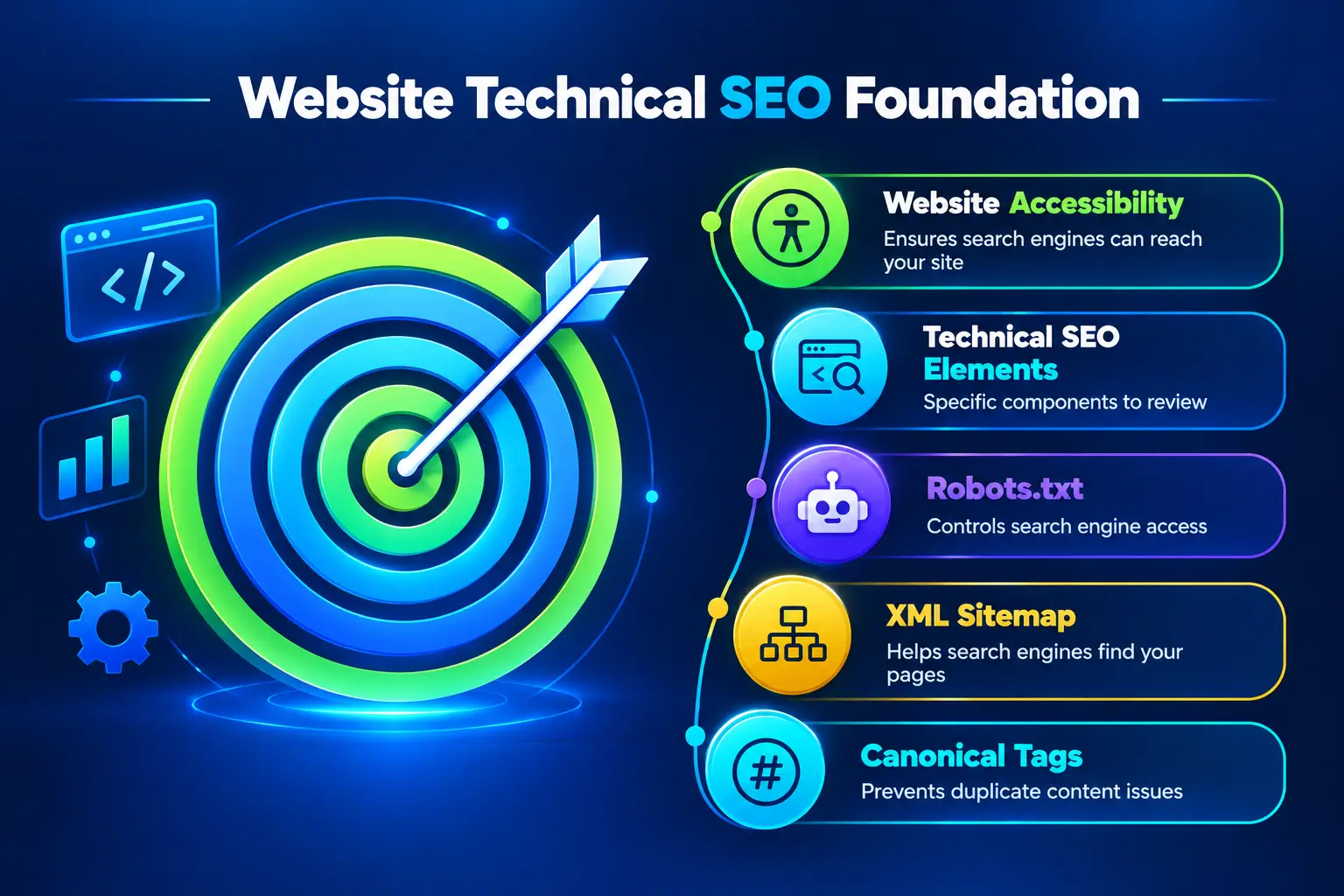
Before trying to improve AI visibility, make sure search engines can properly access your website. Review your robots.txt, XML sitemap, canonical tags, indexability, crawlability, redirects, broken links, duplicate pages, mobile performance, Core Web Vitals, internal linking, and structured data. A technically inaccessible page cannot provide much value regardless of how good its content is.
2Map Content to Search Intent
Don't create content simply because a keyword has search volume — understand what the user wants. For example, the keyword "AI SEO services" likely reflects commercial intent: the user may want to understand the service, compare agencies, learn what AI SEO includes, determine whether they need it, or request an audit. Your page should address those needs.
3Answer the Main Question Early
Don't make readers search through 1,000 words before discovering the answer. Under a relevant heading, provide the core answer first, then expand. For example: "What Is the Difference Between SEO and GEO? SEO focuses on improving visibility in traditional search results, while GEO focuses on increasing the likelihood that your brand or content is represented within generative AI responses. GEO builds on many of the same relevance, authority, and content principles used in SEO." Then explain the details. This structure is useful for users and answer-oriented search experiences.
4Build Topic Clusters
One article is rarely enough to establish authority around a competitive subject. For AI search, build supporting content around topics such as AI SEO, AEO, GEO, Google AI Overviews, Google AI Mode, ChatGPT optimisation, Perplexity optimization, Gemini SEO, entity SEO, Knowledge Graph SEO, AI citation optimization, AI search visibility, and semantic SEO. Then connect these pages through relevant internal links.
5Strengthen Entity Signals
Search systems need to understand what entities represent. Make sure your website clearly establishes the relationships between your business, services, people, locations, industries, and expertise. For Second Silicon Valley, that means creating clear relationships between our company, SEO services, AI SEO, local SEO, national SEO, technical SEO, content marketing, link building, Palo Alto, San Jose, Silicon Valley, and AI search optimization. This creates a clearer semantic relationship between the company and its areas of expertise.
6Demonstrate First-Hand Experience
AI search visibility should not be based entirely on generic information available everywhere. Add original value such as client case studies, campaign insights, original research, ranking experiments, industry observations, before-and-after examples, SEO audit findings, proprietary frameworks, and data-driven analysis. Instead of saying "Backlinks are important," explain "Here is what we observed after analyzing X campaigns..." When the claim is genuinely based on your experience, this adds a much stronger layer of expertise.
7Create Content AI Can Understand
Use a logical structure. For important articles, include a clear H1, descriptive H2s, question-based H3s, short paragraphs, lists, comparison tables, definitions, examples, FAQs, supporting sources, and relevant internal links. The goal is not to "write for robots" — the goal is to make information clear enough for humans and machines to understand.
8Build Authority Beyond Your Website
Your website is not the only source of information about your brand. Build legitimate authority through industry publications, relevant business directories, digital PR, expert interviews, industry associations, partnerships, high-quality editorial links, original research, and brand mentions. For GEO, this is particularly valuable because a brand's reputation and information can exist across multiple sources.
9Optimize Local Search and AI Visibility Together
For local businesses, don't treat Google Maps and AI search as completely separate worlds. Build consistent information around your business name, address, phone, services, service areas, reviews, local content, business categories, local citations, and relevant local mentions. For a company targeting multiple markets, location pages should also provide genuine local value rather than simply swapping city names into duplicate templates.
Want to Know Whether Your Business Is Ready for AI Search?
Second Silicon Valley can evaluate your website's technical SEO, content structure, traditional search visibility, entity signals, and AI search opportunities to identify the areas with the greatest growth potential.
Get Your Free SEO & AI Search Audit →Common SEO, AEO, and GEO Mistakes
Mistake 1: Thinking GEO Means Replacing SEO
It doesn't. SEO remains an important foundation for modern search visibility, including Google's generative search experiences.
Mistake 2: Writing Only for AI
Don't create unnatural content filled with robotic phrases simply because you want an AI system to understand it. Write for humans first, then structure the information clearly enough for machines to interpret.
Mistake 3: Creating Thin AI-Generated Content
Producing hundreds of nearly identical pages doesn't automatically create authority. Content needs purpose, original value, accuracy, expertise, useful information, and relevant context.
Mistake 4: Ignoring Technical SEO
A beautiful article cannot compensate for serious indexing problems, crawl issues, canonical errors, broken internal links, or poor site architecture.
Mistake 5: Chasing AI Mentions Without Building Authority
Trying to force your brand into every AI prompt isn't a sustainable strategy. Build the underlying evidence that makes the brand genuinely relevant.
Mistake 6: Measuring Only Keyword Rankings
Traditional rankings are still useful, but they don't tell the complete story. A modern search strategy should also examine AI mentions, citations, branded searches, organic traffic, qualified leads, conversions, referral sources, and search feature visibility.
How to Measure SEO, AEO, and GEO Performance
The measurement model should match the strategy.
SEO Metrics
Track keyword rankings, organic clicks, organic impressions, CTR, organic traffic, landing-page performance, leads, conversions, and revenue.
AEO Metrics
Monitor featured-answer visibility where applicable, AI Overview visibility, question-based query performance, search impressions, click-through rate, and engagement with answer-focused pages.
GEO Metrics
Track brand mentions in AI responses, AI citations, citation sources, brand accuracy, competitor mentions, AI referral traffic where available, branded search growth, assisted conversions, and visibility across important prompts.
The measurement process should also account for the fact that AI-generated responses can vary based on query wording, context, location, personalization, and platform. Therefore, GEO should be treated as a visibility and brand-monitoring discipline, not simply as another ten-position keyword ranking report.
Do Businesses Need SEO, AEO, and GEO?
For most businesses with meaningful organic-search goals, the answer is yes — but not as three separate campaigns. Think of the strategy this way:
- SEO: Make your website discoverable and authoritative.
- AEO: Make your information easy to understand and answer from.
- GEO: Make your brand and expertise understandable, trustworthy, and relevant within generative search.
A business with weak technical SEO should fix that first. A business with strong SEO but poor content structure should improve answer readiness. A business with strong SEO and content should start building deeper entity authority, original expertise, brand consistency, and AI-search visibility.
A Practical 2026 SEO + AEO + GEO Strategy
For businesses starting today, Second Silicon Valley recommends thinking in phases.
Phase 1: SEO Foundation
Technical SEO audit, keyword research, search-intent mapping, on-page optimization, internal linking, indexation improvements, Core Web Vitals, schema and structured data, and local SEO where applicable.
Phase 2: Answer Optimization
Question-based content, FAQ sections, direct answers, how-to content, comparison pages, decision guides, structured tables, and clear content hierarchy.
Phase 3: AI Search Optimization
Entity optimization, AI-focused content, brand consistency, expert authorship, original research, AI citation monitoring, and generative-search prompt testing.
Phase 4: Authority Building
Relevant backlinks, digital PR, industry mentions, expert contributions, case studies, original data, and high-value content assets.
Phase 5: Measurement and Scaling
Monitor organic rankings, track AI visibility, analyze competitor presence, measure leads and conversions, identify content gaps, refresh existing content, and expand successful topic clusters.
This approach connects the traditional SEO process with the newer requirements of AI-powered search.
Why the Difference Between SEO, AEO, and GEO Matters for Businesses
The biggest mistake businesses can make in 2026 is thinking that search has become one single platform. Customers may discover a company through Google Search, Google AI features, Google Maps, ChatGPT, Gemini, Perplexity, social platforms, brand search, and the website itself. The journey is becoming more fragmented, and your brand needs to be understandable wherever that discovery happens.
For example, someone could search "Best SEO agency in Palo Alto." Another person might ask "How do I choose an SEO company for a SaaS business?" Another could ask "Which agencies specialise in AI search optimization?" These searches have different formats and intents — a modern SEO strategy should be able to address all three.